Lake City Triathlon: the whole story
Nov 15, 2026 · Why we built a party game where a whole room plays a Coeur d'Alene triathlon on their phones, how it went from three events to eight in two days, and what went into it.
Lake City Triathlon is a party game for a whole room. A laptop on a projector shows a lake and a QR code. Everyone scans it, and their phone becomes a controller. Then the room plays three silly events set in Coeur d'Alene, Idaho, and an announcer calls the podium by first name.
This is the long version: where it came from, how a show plays, how it grew, and what's under it.
The idea
It started as one of Jeff's ideas in a brainstorm for a vibe-coding game jam in Coeur d'Alene. The pitch fit in a sentence: a whole room plays on their phones against one big screen. No app, no sign-up, and nobody needs to have seen it before.
The rule we wrote first is humour over sim. Skill is maybe 40% of a result and chaos is the rest. Every pick or shot should end in a story the room retells, and losing has to be as loud as winning: the first award at the podium goes to whoever came dead last. The mishaps are also there to make people look up from their phones and at each other. If you're out, you get a button to bother someone who's still in.
It's local on purpose. The lake in November is cold enough to be the whole joke of the first event. Huckleberries come with a bear. The Coeur d'Alene Resort really does have a floating green. And every town with a lake has a triathlon guy, so he's one of the eight characters a player can be dealt. He hits the ball too far, and sometimes backwards.
How a show plays
The big screen runs itself. With nobody playing, the camera drifts along the shore and the screen cycles through the events next to a big QR code. The first phone to join starts a countdown, the announcer welcomes each walk-up ("And Jen is in!"), and bots fill the field to eight. You type a first name if you like, and pick a colour and an emoji. That pair is how you find yourself on the big screen all night.
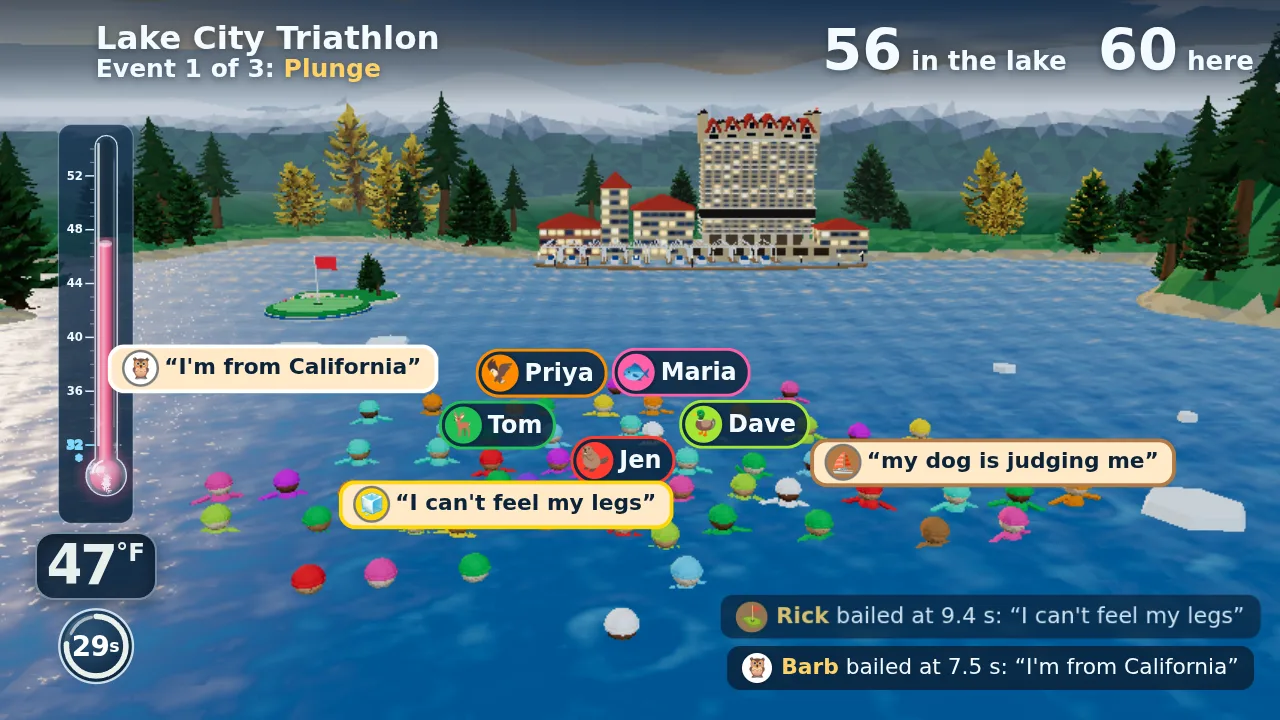
Every show opens with Plunge. Hold a finger down to stay in the lake; lift it and you're out, with your excuse up on the big screen ("my dog is judging me"). Your phone lies to you the whole time, and the best lie comes late: a fake incoming call from Mom, drawn to look like your own phone's call screen. Only the horn ends it.
Then a slot machine draws two more events from seven, and the announcer reads them out. No two events in a show share a verb, and every event comes up before any repeats.
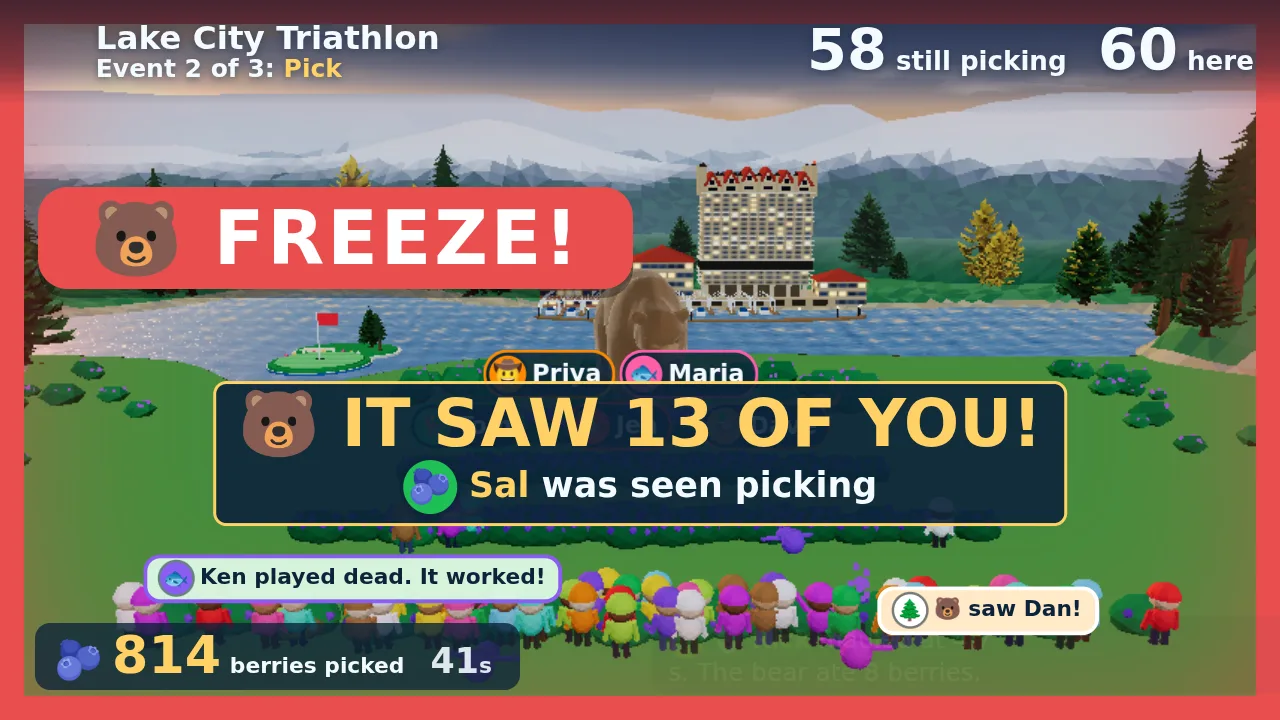
Pick is huckleberries with a bear's back to the room. Tap to pick, and freeze when it looks. If it saw you, you can play dead, which works 45% of the time. If you're mauled, you can snitch on someone who's still picking.
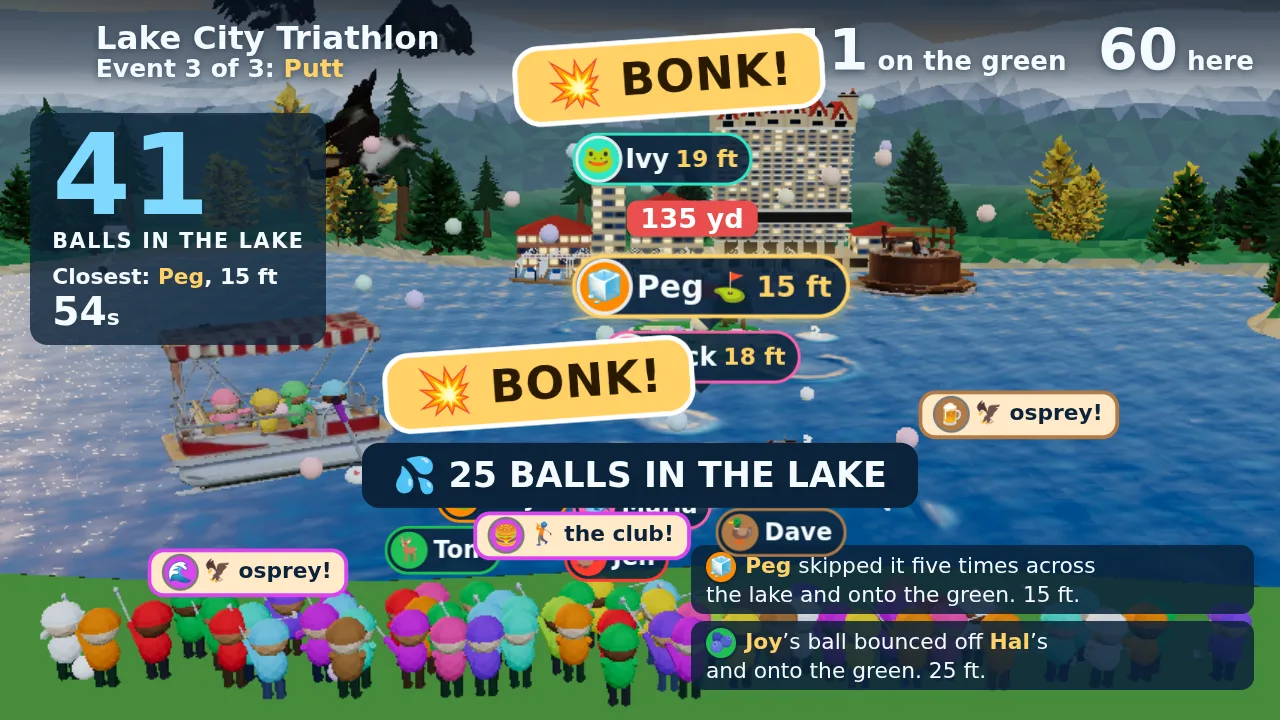
Putt is the floating green. Flick up to tee off, as often as you like. One swing in four is a disaster: the hot tub, a pontoon party, an osprey. Twice a round the lake stops for one golfer, and every other phone becomes a COUGH button.
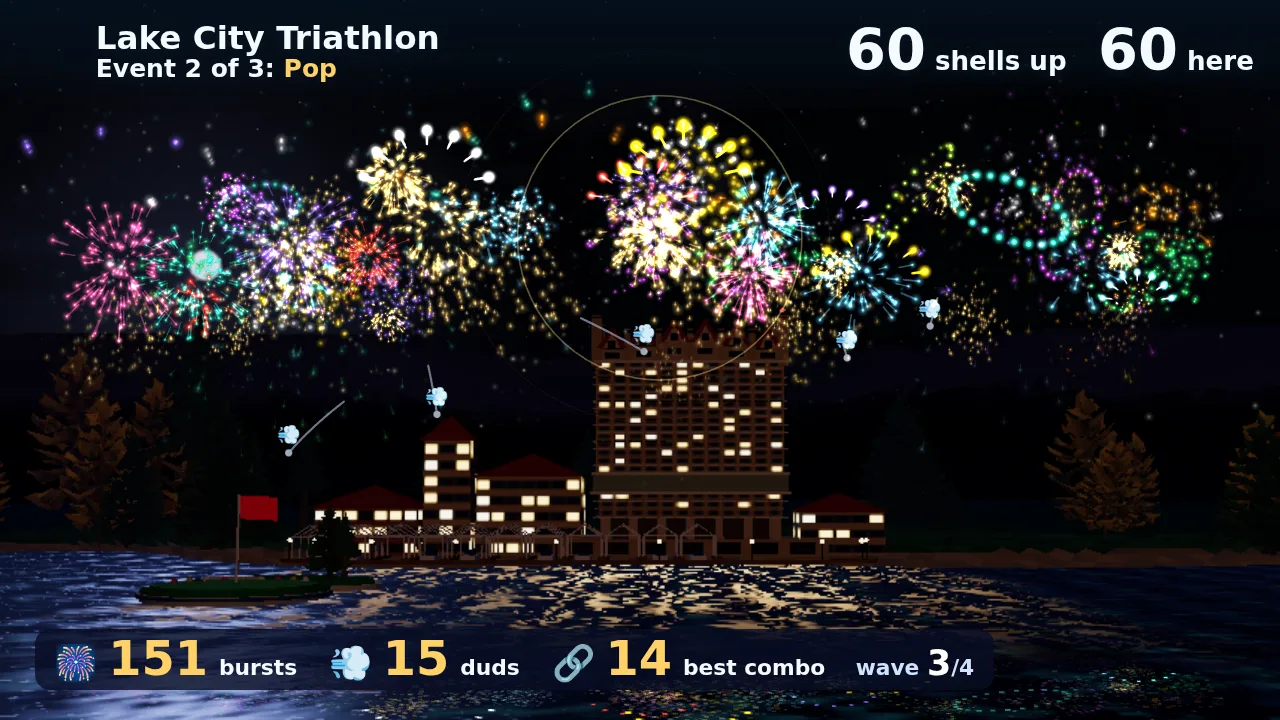
Pop is fireworks at night in front of the Resort. Tap when your shell reaches the top. Tap late and your dud comes down on the Resort roof.
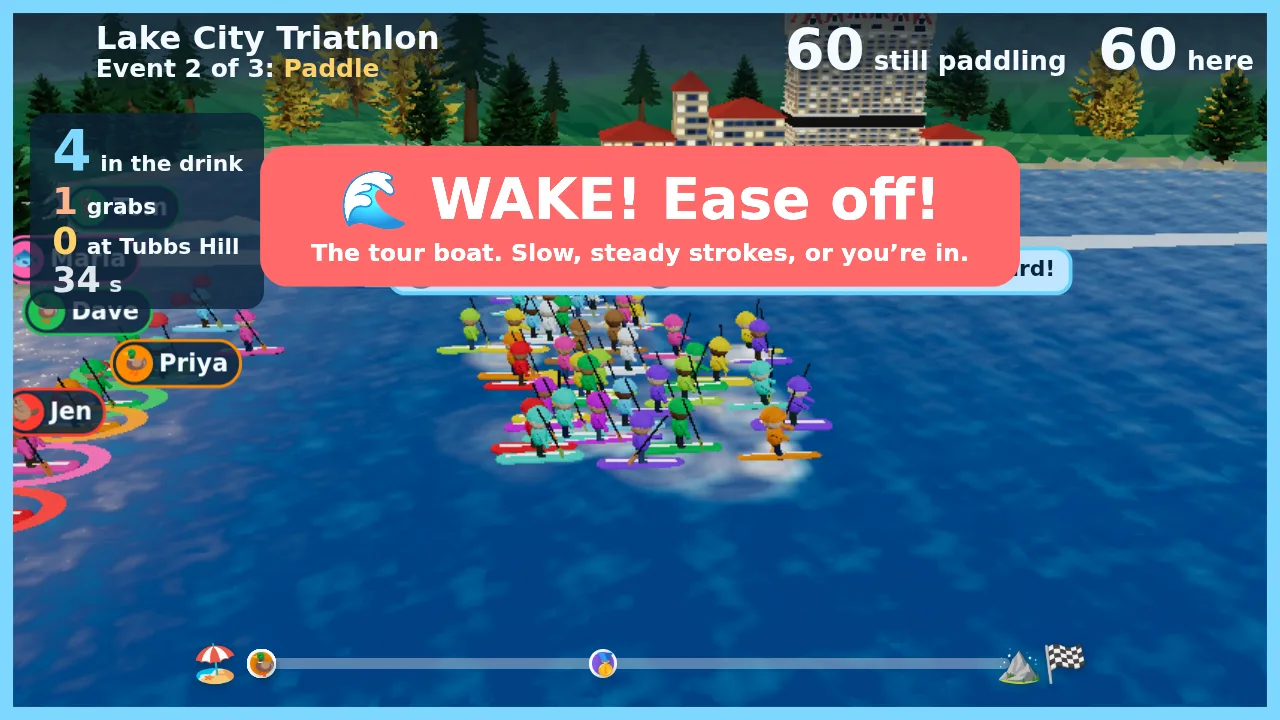
Paddle is a paddleboard race to Tubbs Hill. Tap left, right, left, right, and ease off when the tour boat's wake comes through.
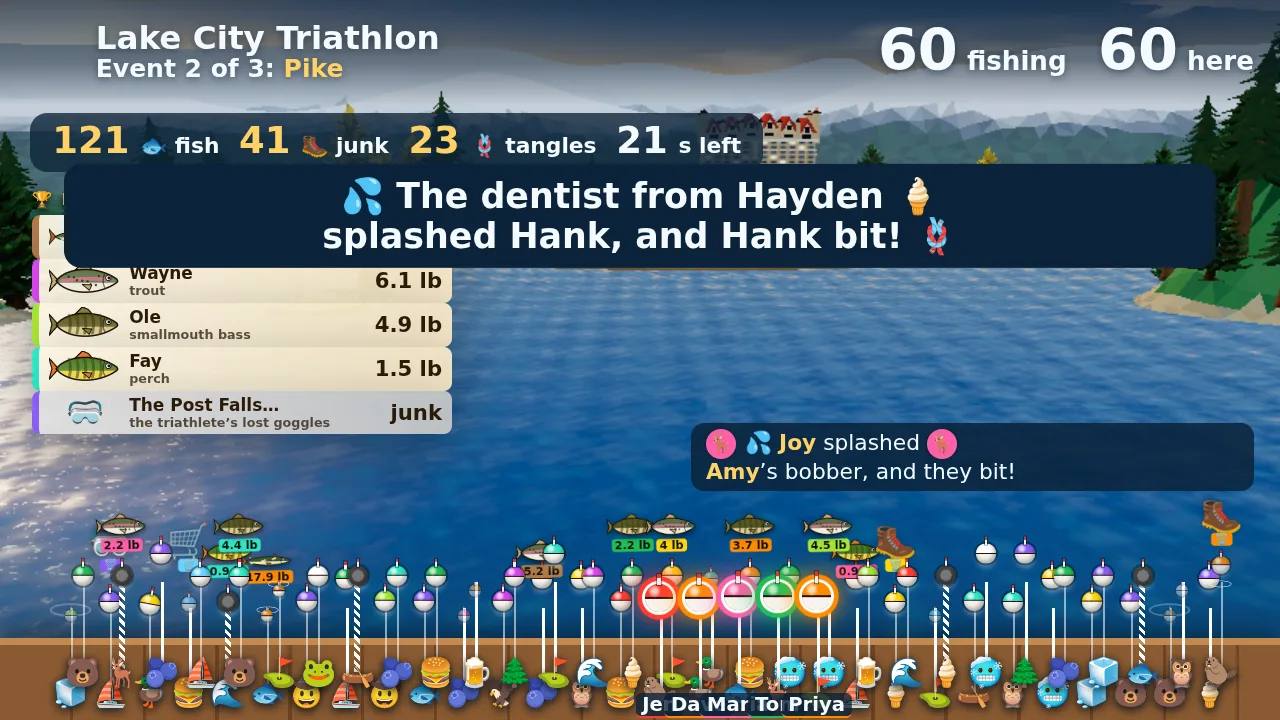
Pike is fishing off the boardwalk. Wait for the bite, then strike. You might land a 31 lb northern pike, or a boot.
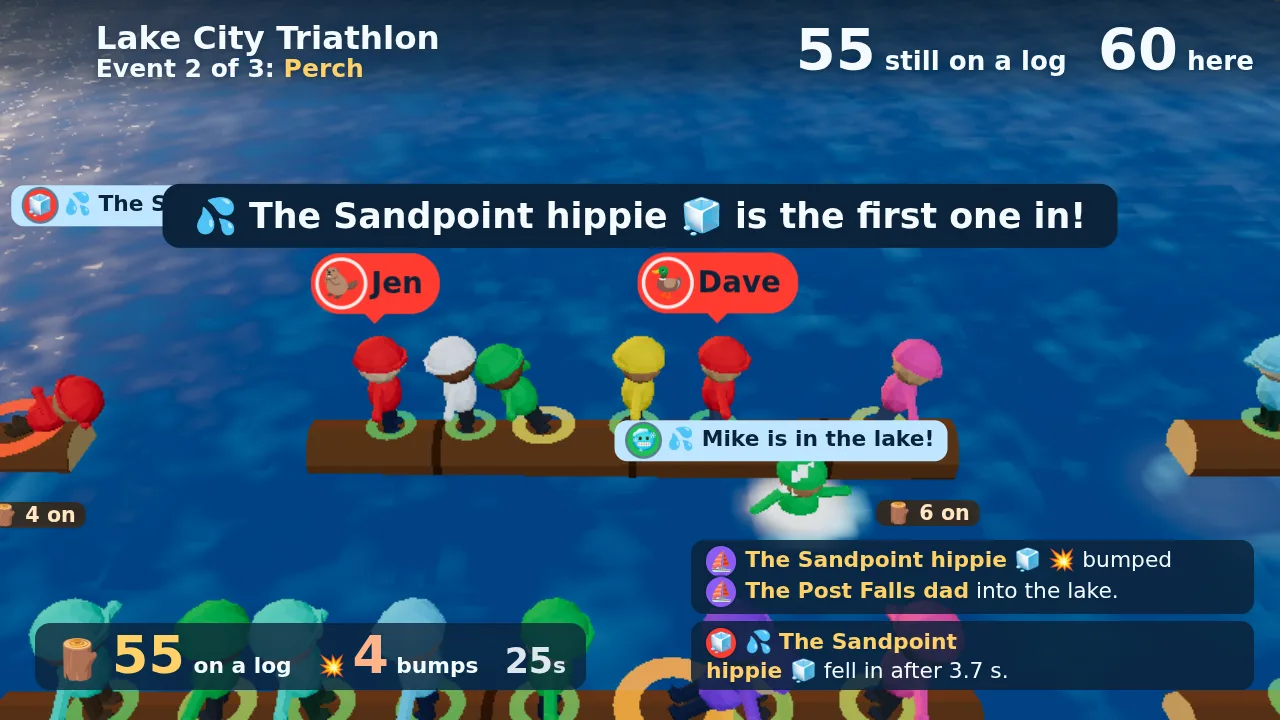
Perch is log rolling. Tipping left? Press right. Once you're in the lake you can bump the log you fell off.
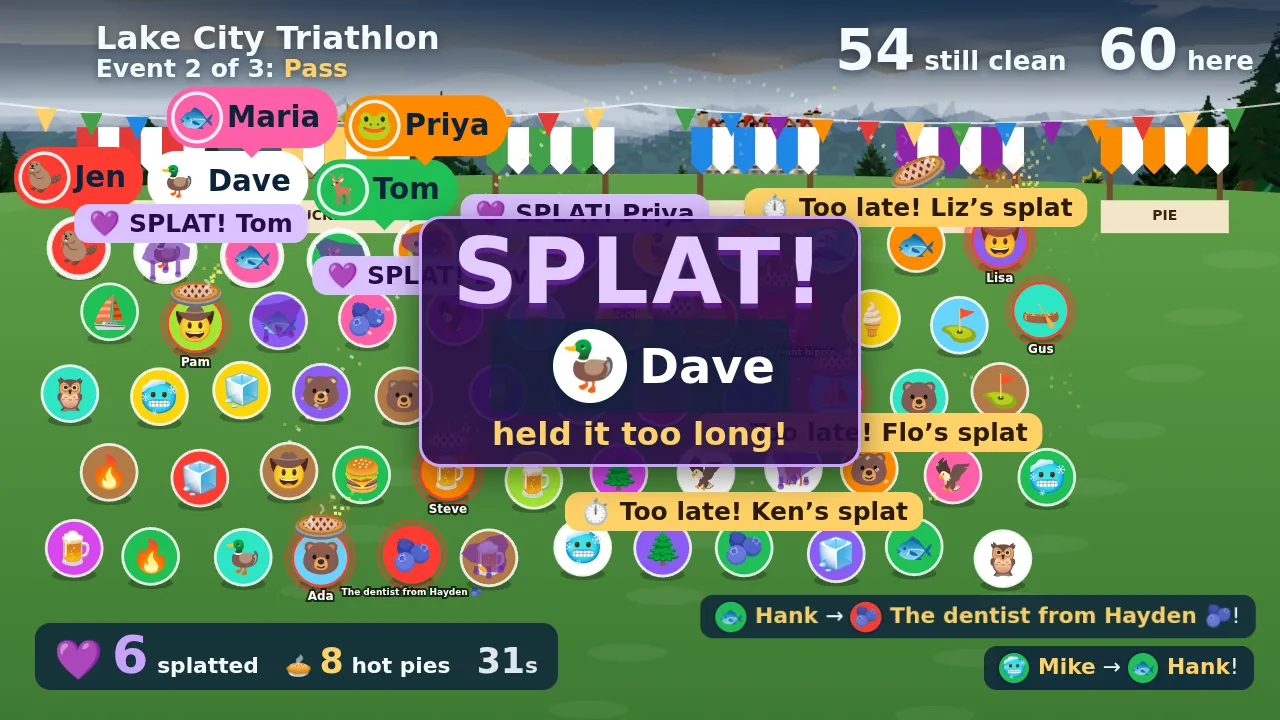
Pass is hot huckleberry pie. If you're holding one, pass it before it pops.
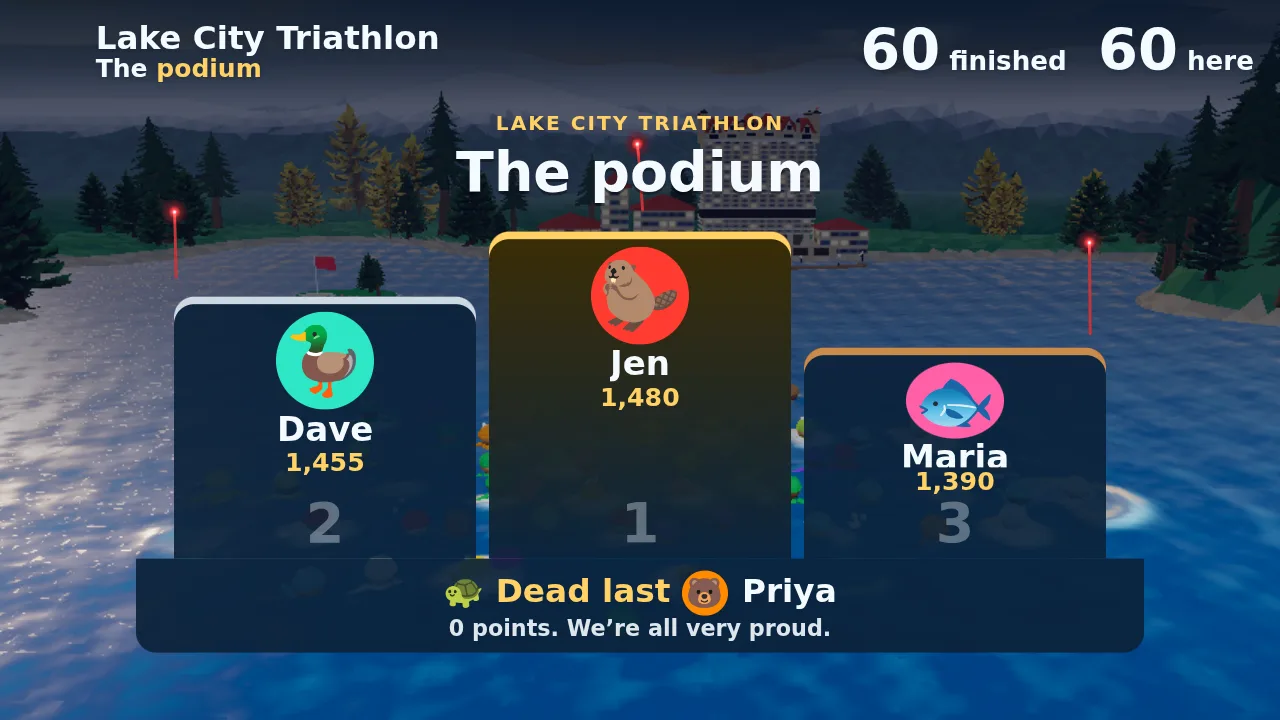
The show ends on a podium that takes its time. First come the awards nobody wanted, one at a time: dead last, the Lake Champion for the most balls in the water, the excuse of the day. Then third, second, a drumroll, and the champion's name over the whole screen with confetti, and fireworks over the lake. Then it's back to the shore for the next show.
Each event has a page of its own with how to play it.
How it grew
The first commit was at 8:22 pm on Friday, November 13. By midnight there were three events, Plunge, Pick and Putt, and a short launch note.
Saturday was about clarity. The show is fast and runs in front of strangers, so Jeff set rules that every event has to follow. An intro card comes first, on the big screen and every phone at once: the event's name, its one verb, the goal in one line, a little animation of the gesture, then 3-2-1. The phone shows one instruction, big, and extra buttons appear only when they work. You always know which one is you. And text never wraps badly, which now has a test of its own that walks the whole show at five screen sizes.
Over the same day and night the look went from placeholder to something we'd put on a projector. The lake got real water and a low autumn sun. The bear became a 3D grizzly that charges. The Resort was redrawn after the real one, with its red gables and boat slips. The box-edged pond became a shore with coves, tamaracks gold for November, and ridgelines with snow.
Sunday it stopped being three events. Each event became a module, the show learned to draw a lineup, and five new events landed within about fifteen minutes of each other that morning. The lobby got a host who warms up the room, and the podium became a ceremony.
One change nobody sees: the tests. By Saturday night the full browser check took about nine minutes, because it played the show at its real pace, and some of its checks failed on one run and passed on the next. Builds were spending most of their time waiting on it. Now it runs the show's clock ahead between checks and waits on the game's state, and the whole show is checked in about two minutes.
The build-by-build version, with a time-lapse made from the game's own git history and what it took in build hours and tokens, is a post of its own.
What went into it
A late message never punishes anyone. A hundred phones on venue Wi-Fi will not all hear "the bear turned" at the same moment. So nothing timed is sent as it happens. The bear's turns come from a seed that goes to every phone before the event, the phones share the room's clock, and each phone judges its own taps. It only tells the big screen the outcome. In a test through the live room, 100 simulated phones' clocks were a median 4 ms from the big screen's, and none that stopped in time was mauled. Every event since works the same way.
The room only carries messages. The big screen runs the rules. A room is one small Durable Object on Cloudflare that passes messages between it and up to 200 phones, and each phone batches its inputs to about five sends a second. We test with 100 simulated phones: no inputs lost, and a median delay of 75 ms from phone to screen. An empty room sleeps. A big screen left in attract mode for 17 minutes was billed for 0.26 seconds of room time, and a phone that scanned the sleeping room was in after 0.37 seconds.
The announcer is recorded, never live. He's 168 lines and 351 first names, all ElevenLabs clips made ahead of time and spliced when he speaks: a name, then "…into the lake. Again!". Nothing calls an API during a show. If your name isn't one of the 351, he calls you by your character, such as "the dentist from Hayden".
Names stay in memory. A first name is cleaned on the server, never stored or logged, and gone when the room closes. The presenter can hide any name from the big screen.
Bots play everything. Each event's rules are a plain file with no screen attached, and each event has bots. That's why "Try it alone" works with 45 of them, why the promo could be filmed from the real game, and why the rules can be played through in about three seconds in a test.
The lake. It's three.js. The water and sky are borrowed from two of our own games, Far Shore and Wakeout, with a quality ladder that steps down when frames get slow. The grizzly, the osprey, the bald eagle, the pontoon, the jet ski, the hot tub and two of the trees are generated models: an image made into a mesh on fal.ai, then cleaned or rigged in Blender. The Douglas fir came from Meshy, reused from another of our games. The players, the Resort and the floating green are built in code, so 200 little people stay cheap to draw.
How it was built. Almost none of it was typed by a person. Jeff filed issues, and our build pipeline, which we call cowboy, had an AI agent build each one, test it and merge it. Jeff steered, decided and tried each change on the live page between items. As of Sunday afternoon that's 52 issues filed, 76 merge requests merged and 169 commits, about 44 hours after the first one.
What we don't know yet
On record, it has only been played by bots and test phones. The announcer's clips have been checked by transcribing them back, not heard in a room. The timings are guesses until a real evening. So if you have a projector and a few friends, host one: open the game, choose "Host on a big screen", and let people scan. Then tell us how it went.
How Lake City Triathlon was made: the launch note, Nov 14, 2026